



Blog
Open Plan Offices Were Supposed to Fix Everything. Here’s What They Actually Broke

Open plan offices arrived with considerable confidence. Pull down the walls, remove the partitions, and suddenly everyone would collaborate spontaneously. Ideas would flow across desks. Managers would be accessible. Teams would feel connected. The office would become a living organism of productivity.
What actually happened, in many workplaces, was noise. Constant, low-level, relentless noise. The sound of nearby conversations bleeding into focused work. The inability to take a call without performing for the whole floor. The cognitive taxation of processing background speech while trying to think clearly. The creeping loss of any meaningful privacy, visual or acoustic.
Research has consistently shown that noise and distraction are among the primary factors affecting productivity and satisfaction in open plan workplaces. The solution that emerged from this realisation was not to rebuild the walls. It was something far more flexible, practical, and cost-effective: room dividers, acoustic screens, and partition systems that create separation and control without permanence.
This article looks at what those products actually are, how they work, and how to choose the right one for the problem you are actually trying to solve.
Noise Is Not Just Annoying. It Is a Workplace Health Issue.
Before getting into products, it is worth understanding the scale of the problem that acoustic partitions and room dividers are addressing.
Safe Work Australia establishes clear obligations for businesses to manage the risk of noise-related harm. While industrial noise at hazardous decibel levels is the primary focus of that framework, the broader principle is instructive: noise in the workplace is not just a comfort issue. It affects the health, safety, and wellbeing of workers.
In office environments, the relevant harm is cognitive rather than auditory. The brain’s effort to filter out intrusive speech while maintaining focus creates mental fatigue that accumulates across the day. Workers in open plan environments without adequate acoustic separation consistently report higher rates of fatigue, lower job satisfaction, and reduced ability to concentrate on complex tasks than those in better-managed acoustic environments.
Addressing that through physical separation, whether acoustic screens, room dividers, or partition panels, is not a luxury fitout decision. It is a practical response to a documented impact on how well people can actually do their work.
What Room Dividers Actually Do
The term room divider covers a wide range of products with meaningfully different capabilities. Understanding what each type does, and does not do, prevents the common mistake of buying a product that addresses the wrong version of the problem.
The most basic function of any room divider is creating a visual boundary. This removes the distraction of peripheral movement, provides a degree of privacy, and signals that the area is not open for casual interruption. Visual separation alone meaningfully reduces distraction.
Screens with acoustic foam, fibreglass, or mineral wool infill materials absorb sound waves rather than simply blocking line of sight. These products reduce the transmission of speech and background noise, directly addressing cognitive fatigue.
Beyond noise and privacy, room dividers define zones. A cluster of workstations behind a screen becomes a team zone. A sectioned-off area becomes a quiet room. A partition in a training space creates a smaller breakout environment.
Many commercial room dividers and acoustic screens include pinnable or magnetic surfaces that can be used for displaying project information, team notices, or reference material, turning a passive barrier into an active tool.
Acoustic Screens: When Noise Is the Primary Problem
If the main problem in your workspace is noise and conversational distraction, an acoustic screen is the most targeted solution. These are freestanding or desk-mounted panels designed specifically to absorb and deflect sound, typically with a fabric-wrapped acoustic infill that softens the environment around the screen.
Freestanding acoustic screens are among the most versatile products in this category. They stand independently on feet or bases, require no installation, and can be repositioned as the space or team configuration changes. A free standing acoustic screen is a practical example of this category, designed for open plan offices where flexibility and portability are priorities alongside sound absorption.
What to look for in an acoustic screen. The fabric covering matters both aesthetically and functionally. Commercial acoustic fabric should be durable, cleanable, and chosen from a range that suits the overall colour palette of the space. The infill material and density determine the acoustic performance. Look for products with independently tested NRC ratings if acoustic performance is the primary requirement.
Height considerations. A screen that sits at seated eye height, around 1200mm, provides visual privacy for someone at a workstation but does not interrupt the sense of openness in the room. A screen that extends to 1600mm or above begins to create a more enclosed zone, with correspondingly greater acoustic effect. Full-height screens, at 1800mm and above, approach the effect of a temporary room within the space.
Find the Right Acoustic Screen
For businesses that need help specifying the right acoustic configuration to manage noise on a busy floorplate, the full range of sound-absorbing screens is available at Abbotts Office Furniture.
The Communicate Room Divider: Where Collaboration and Separation Meet
One of the more intelligent design challenges in open plan workspaces is the tension between creating separation and maintaining connection. A wall solves the noise problem but cuts off the communication between teams. An acoustic screen helps with distraction but cannot serve as a communication tool.
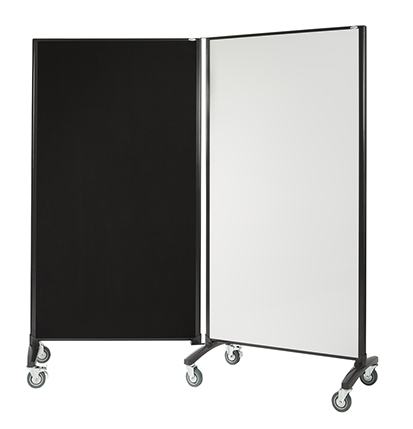
The Communicate Room Divider addresses this directly. It provides physical separation while incorporating surfaces that teams can write on, post to, or display information across. In effect, it turns the boundary between two zones into a shared communication resource rather than a blank barrier.
This type of product is particularly effective in collaborative workplaces where different project teams need clear spatial separation without the isolation of a fully enclosed room. The physical demarcation helps each team maintain focus while the writable or pinnable surface allows information to be shared across the boundary in a way that a plain partition cannot support.
Enable Better Collaboration
If you need to define zones without sacrificing team communication, explore versatile whiteboard and display dividers designed for agile, collaborative workspaces.
Pinboard Panels: Room Dividers That Pull Their Weight
A room divider that only creates visual separation is doing one job. A pinboard panel does that and also functions as a daily-use display and organisation surface. In workplaces where visual communication is central to how teams work, this combination makes pinboard panels one of the most practical options available.
The modulo mobile pinboard and T-leg pinboard models are purpose-built for exactly this use. The mobile version rolls on castors, which means it can be repositioned as the team’s needs change throughout the day or week. The T-leg version provides a stable fixed position suitable for spaces where the panel will stay in one location.
Where pinboard panels deliver most value. Project-based teams that run visual management processes, like task boards, sprint planning walls, or project status displays, benefit most from pinboard panels used as room dividers. The boundary between the team zone and the rest of the office becomes the team’s active workspace rather than dead vertical real estate.
For agile teams, design studios, marketing departments, and any group that works with visual information pinned and organised in physical space, a pinboard panel room divider is significantly more useful than a plain acoustic or fabric screen.
Maximize Your Vertical Space
Transform dead barriers into active workspaces. Discover mobile and fixed pinboard panels perfect for project planning, visual management, and team organisation.
The Zip Acoustic Panel: Targeted Sound Control
Not every noise problem in an open plan office is a room-wide one. Sometimes the issue is more localised. A cluster of desks near a kitchen or corridor. A small team whose work involves a lot of phone or video calls. A workstation adjacent to a printer station that generates constant background sound.
For targeted acoustic management, a product like the Zip acoustic panel provides sound absorption precisely where it is needed without the scale and cost of a full partition system. These panels can be deployed individually or in combination to address specific noise sources or circulation paths that are creating distraction problems for particular parts of the floor plate.
The advantage of targeted acoustic panels over full room dividers is proportionality. If the problem is a specific zone rather than the whole floor, the solution should match that scale. Installing a full partition system to address a localised noise issue is over-engineering the response. A targeted acoustic panel addresses the specific problem without reorganising the whole space.
Targeted Noise Solutions
Stop noise at the source. Find targeted acoustic panels and flexible sound-absorbing screens to quiet specific problem areas within your open plan office.
Choosing Between Fixed and Mobile Dividers
One of the most important and most commonly under-thought decisions in buying room dividers and screens for an office is whether the solution needs to be fixed in place or mobile.
Fixed or stable dividers suit spaces where the layout will not change frequently and where the primary need is permanent or semi-permanent separation. T-leg pinboards, heavier acoustic screen systems, and larger partition walls fall into this category. They provide a more resolved, intentional look and feel more like part of the space rather than an overlay on it.
Mobile or repositionable dividers suit spaces that change configuration regularly, that host different types of activity at different times, or where teams grow and contract in ways that alter their spatial footprint. Mobile pinboards, castored acoustic screens, and lightweight folding panel room dividers give these spaces the ability to respond to changing needs without a new fitout decision every time the team or programme changes.
The right answer depends on the stability of the layout you are dividing. If the answer is “this is how the office will look for the next five years,” a more fixed solution is appropriate. If the answer is “it depends on the project,” a mobile or repositionable solution will serve better.
What to Check Before You Order
Room dividers and acoustic screens look straightforward but a few dimensions and details need confirming before any order is placed.
- Floor clearance and stability. Freestanding screens need to be stable at their specified height. Check that the base or foot configuration provides enough stability for the height of the panel, particularly in spaces with foot traffic moving past them. A tall panel on an undersized base is a safety risk.
- Surface compatibility. Some screens are designed to sit on carpeted floors, where the feet grip effectively. On hard flooring, the same screen may slide under contact. Check that the base is appropriate for the floor surface the screen will live on.
- Acoustic ratings. If acoustic performance is the primary requirement, ask for the NRC rating of the product and understand what it means. An NRC of 0.5 means the panel absorbs 50% of the sound that strikes it. An NRC of 0.8 or above is considered high-performance acoustic treatment.
- Dimensions relative to existing furniture. A screen that is 1600mm tall next to a 1200mm bookcase will look mismatched. Confirm heights relative to adjacent furniture and architectural elements before ordering.
- Fabric durability and cleanability. Commercial fabric screens will accumulate dust, occasional marks, and the general wear of a busy office environment. Ask about the cleanability of the fabric before committing, particularly for screens that will be used as pinboards where repeated pinning will eventually affect the fabric surface.
The Bigger Picture: Room Dividers as Workplace Strategy
There is a temptation to treat room dividers and partition screens as a reactive purchase, bought in response to a specific noise complaint or a layout problem that has already become a frustration. That approach usually leads to under-specified products deployed in ways that partially address the problem rather than solving it.
The more effective approach treats acoustic and spatial separation as part of the initial workplace design rather than a remedy applied afterwards. A floor plan that identifies which zones need acoustic separation, which teams need visual privacy, which areas need the flexibility to reconfigure, and which surfaces should double as communication tools will arrive at a much more considered specification than one that asks “what can we put here to make it quieter.”
The product range available to support this approach is broad and genuinely flexible. Acoustic screens that absorb sound, pinboard dividers that enable visual communication, mobile systems that adapt to changing team configurations, and targeted acoustic panels for specific problem zones. Used together or individually, these products can significantly change the acoustic character and spatial organisation of an open plan office without a single wall being built.
Frequently Asked Questions
Do room dividers actually reduce noise, or do they just block the view?
It depends on the product. Plain visual screens reduce distraction by removing line of sight but do not significantly reduce noise transmission. Screens with acoustic infill materials, and products with a published NRC rating, absorb a measurable proportion of the sound that reaches them. For noise reduction, you need a product specifically described as acoustic, not just a partition or visual screen.
Can I use room dividers to create a temporary meeting room?
Yes. A combination of freestanding acoustic screens arranged around a table can create a functional semi-private meeting space without construction. The acoustic performance will be less than that of a built room, but it significantly reduces the conversational disturbance to and from the surrounding open plan area. This approach works particularly well for short meetings and one-on-ones.
How many room dividers do I need?
This depends on the size of the zone you are creating and the degree of separation needed. A basic visual boundary around a desk cluster might need two or three panels. A more enclosed zone for a small team might need five to eight panels arranged in a loose U or square shape. Most suppliers can advise on the number and configuration for a described space.
Are folding panel room dividers suitable for a professional office environment?
Quality folding panel room dividers are entirely appropriate for professional commercial settings. The key is choosing a commercial-grade product with a stable hinge system, a professional fabric or surface finish, and adequate height for the purpose. In practice, a well-specified folding panel divider is indistinguishable from a fixed screen when it is in use.
Can room dividers be used in healthcare or education settings?
Yes. Commercial room dividers and acoustic screens are widely used in healthcare waiting rooms, consultation areas, and clinical administration environments, as well as in school and university settings for flexible learning space management. The specific product should be chosen for its cleanability and durability in those contexts.
How do I stop screens from sliding on hard floors?
Most commercial acoustic screens designed for hard floor use come with rubber-tipped feet or base plates that grip without scratching the surface. If you have screens designed for carpet that are being used on hard flooring, adhesive non-slip pads can be applied to the foot contact points. For frequently moved screens, rubber-wheeled castors are a better solution than fixed feet on smooth surfaces.
What is the difference between a room divider and an acoustic panel?
A room divider is primarily a spatial product. Its main function is to create a visual boundary between zones. An acoustic panel is primarily an acoustic product. Its main function is to absorb sound and reduce noise transmission. Many products combine both functions, using an acoustic infill behind the divider surface to provide sound absorption alongside visual separation. When both functions are needed, look for a product that specifies both visual and acoustic performance.


