



Blog
The Underrated Office Piece That Does More Than You Think

The Piece Nobody Talks About Until They Buy One
Office furniture conversations tend to orbit the big ticket items. The desk. The chair. The meeting table. The things that feature in product photography and get debated in fitout briefs. The credenza rarely makes it into that conversation early, and yet, in almost every well-considered office interior, it is doing some of the most useful work in the room.
Ask anyone who works in an executive office fitted with a credenza desk and they will tell you they cannot imagine the space without it. Ask someone who has just set up a new office without one and they will tell you they are running out of places to put things. The credenza is the furniture equivalent of realising you needed a junk drawer. Except it is not a junk drawer. It is the opposite of one.
This article is not a buying guide with bullet-pointed features. It is an honest look at what an office credenza actually does, why it belongs in more workplaces than it currently occupies, and how to think about the right one for your space.
Table of Contents
- What Is a Credenza, and Where Did It Come From?
- What a Credenza Actually Does in an Office
- The Credenza Desk Configuration: Getting the Relationship Right
- Credenza Types and What Each Suits
- Credenzas in Spaces Beyond the Executive Office
- Materials and Finishes: What Holds Up
- The Ergonomics Side of the Credenza
- Before You Buy: Sizing Up the Space
What Is a Credenza, and Where Did It Come From?
The word credenza has its roots in Renaissance Italy. Originally it described a sideboard used by servants to taste food and drink before it was served to nobility, a precaution against poisoning. The act of tasting was called the credenza, meaning trust or belief. Over centuries, the furniture piece evolved from a servant’s testing station into a formal dining sideboard and then, through the mid-twentieth century, into the low-profile storage cabinet that became standard issue in executive offices across the corporate world.
By the time the open-plan office arrived and began dismantling corner offices and private suites, the credenza had already established its usefulness so thoroughly that it simply adapted. Today it appears in executive suites, open workspaces, boardrooms, reception areas, home offices, and co-working facilities, serving different functions in each but maintaining the same basic proposition: structured, accessible storage with a usable surface on top, sized to work alongside a desk rather than compete with it.
What a Credenza Actually Does in an Office
Storage is the obvious answer, but it is not the complete one.
- It manages the desk surface. The most immediate effect of adding a credenza desk configuration to a workspace is that the main desk surface stays clearer. Everything that used to crowd the desk, the printer, the document trays, the reference files, the chargers, the stationery, the things that accumulate without quite knowing how, finds a home on or within the credenza. The result is a desk surface that functions as a thinking and working space rather than an overflow area.
- It creates a second work surface. The top of an office credenza is one of its most practical and most underused features. At roughly 720mm to 750mm high and typically 400mm to 500mm deep, the credenza surface is ideal for a printer, a second monitor in a multi-screen setup, a hospitality station with coffee and water, a document signing area, or a display surface for reference materials or objects that matter to the person working in the space.
- It anchors the room. In executive offices and private suites, the desk and credenza combination creates a defined working zone. The credenza behind the desk turns a chair into a position with weight and deliberateness. It anchors the occupant in the room and gives visitors a clear sense of the spatial hierarchy. This is not about status for its own sake. It is about the practical fact that an office that reads clearly gives everyone in it a sense of orientation.
- It handles the things that should not be visible. A credenza with closed doors or drawers keeps files, equipment, and everyday supplies accessible without putting them on display. In offices where clients visit, the ability to tuck the working mechanics of the day away without packing them up is genuinely valuable. The credenza office setup allows a space to shift registers quickly from operational to presentational.
- It absorbs the expansion that happens naturally over time. Offices accumulate material. It is not a failure of organisation; it is the natural consequence of doing actual work. A credenza gives that material somewhere to go that is structured rather than chaotic.
The Credenza Desk Configuration: Getting the Relationship Right
The desk and credenza pairing works best when it is treated as a deliberate relationship rather than two separate purchases. The height of the credenza relative to the desk, the depth of each, the finish match or contrast, and the physical positioning all affect how the configuration reads and functions.
The most common arrangement places the credenza directly behind the primary desk, creating a U-shaped working zone when the occupant swivels their chair. This is efficient and practical. Everything within the credenza is accessible without standing, and the surface behind the desk is always within reach.
A right-angle arrangement, with the credenza perpendicular to the desk rather than parallel, creates an L-shaped configuration and works well when the room is longer than it is wide. This keeps the full credenza surface accessible without the occupant having to fully turn around, which suits spaces where the credenza surface is actively used for work rather than just storage.
Some offices position the credenza against a wall away from the desk entirely, using it more as a room feature than a working component of the desk setup. This works well when the credenza is primarily used for files, equipment, or display rather than active daily reference.
Whichever arrangement you choose, the finish of the credenza should be decided in relation to the desk. A matching finish creates a cohesive, resolved look. A contrasting finish, a light desk with a dark credenza or vice versa, can add visual interest in spaces with good natural light and enough volume to carry the contrast without the room feeling split.
Credenza Types and What Each Suits
Not all office credenzas are built for the same purpose. Understanding the different configurations helps narrow the decision quickly.
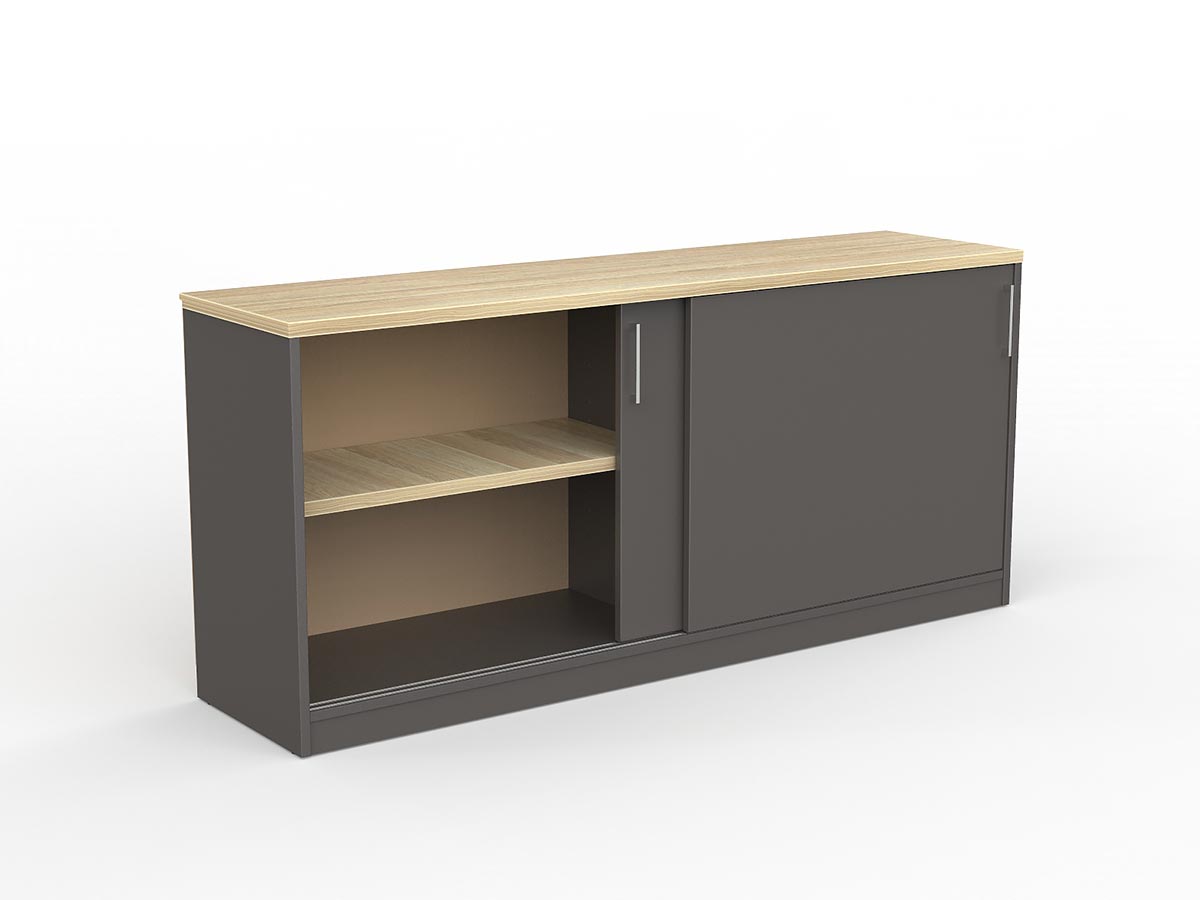
- Sliding door credenzas. The most widely specified credenza type in Australian commercial fitouts. Sliding doors eliminate the clearance requirement of hinged doors, which makes them practical in offices where floor space is limited or where the credenza is positioned close to a wall or window. The smooth movement of sliding doors also holds up well under daily use without the hinge wear that affects swing doors over time. These suit most executive office and private workspace applications.
- Drawer-only credenzas. Configured entirely with drawers rather than doors, these suit offices with high volumes of frequently accessed documents and small items. The trade-off is reduced volume storage compared to a shelved interior, but the access speed is unmatched for active reference material.
- Combined door and drawer credenzas. The most versatile configuration. Typically features drawers on one end for frequently accessed items and a shelved, door-fronted section for larger files, equipment, or items that only need occasional access. This suits most mixed-use office environments.
- Hutch-topped credenzas. An open shelving unit that sits on top of the credenza, extending storage vertically and creating a display or reference zone above the main cabinet. These work well in private offices where vertical space is available and where the occupant wants to keep reference books, awards, or personal items accessible and visible.
- Credenzas with integrated technology provisions. Increasingly specified in contemporary fitouts, these include cable apertures, power access, and internal shelving dimensioned for specific equipment. They are worth specifying when the credenza will house a printer, networking equipment, or other technology that needs consistent power access and cable management.
Credenzas in Spaces Beyond the Executive Office
The credenza’s reputation as an executive office piece has sometimes limited thinking about where else it belongs. In practice, credenzas work exceptionally well in several other settings.
- Boardrooms and meeting rooms. A credenza along one wall of a boardroom serves as a hospitality station, houses the AV equipment and cabling, provides storage for presentation materials and stationery, and gives the room a resolved, finished look. Boardrooms without a credenza often feel unanchored, with equipment sitting on the floor or on temporary tables.
- Reception areas. A low credenza in a reception zone creates a visual anchor without the formality of a full reception counter. It is particularly useful in smaller reception areas where a full counter would overwhelm the space but some storage and surface area are still needed.
- Open-plan workspaces. In open-plan environments, a credenza at the end of a workstation run or along a perimeter wall creates a team storage zone that keeps individual desks free. This is especially effective in smaller teams that do not have the volume to justify a full storage wall but need more than a set of personal drawers.
- Home offices. A home office fitted with a desk and credenza combination presents better on video calls, keeps the working space more disciplined, and avoids the accumulation of clutter that makes home offices difficult to sustain as productive environments.
Materials and Finishes: What Holds Up
The material and finish decisions for an office credenza matter more than they sometimes seem at the point of purchase. A credenza is handled every day, often multiple times. Drawers and door handles accumulate fingerprints. Surfaces collect incidental marks from documents, cups, and equipment. The wrong finish on a high-touch piece will show its age quickly.
- Melamine. The most common material in commercial office credenzas in Australia. Hard-wearing, easy to clean, and available in a wide range of finishes that convincingly replicate timber, stone, and solid colour. Commercial-grade melamine resists scratching and retains its appearance well under sustained daily use. The right choice for most office applications.
- Timber veneer. Used in higher-specification executive fitouts where the texture and warmth of real timber is a design requirement. Timber veneer credenzas need more careful handling than melamine equivalents and should be cleaned with appropriate products. They age well if maintained correctly and carry a material quality that reads distinctly in a room.
- Laminate over MDF. A cost-effective option that can deliver good visual results but is more vulnerable to edge damage and moisture than commercial melamine. Appropriate for lower-traffic applications or where budget is the primary constraint.
- Powder-coated steel. Sometimes specified for bases, frames, or partial elements in contemporary fitouts. Durable and clean-looking, it pairs well with timber or stone-finish tops in mixed-material designs.
The Ergonomics Side of the Credenza
This is not usually part of the credenza conversation, but it should be. Safe Work Australia’s guidance on sitting and standing at work notes that workers should not remain in the same static posture for extended periods and that workstations should be designed to encourage movement and postural variation.
A credenza desk configuration naturally supports this. When a worker needs to access the credenza behind them, they move. They swivel, reach, stand, and return. In a workday that might otherwise be spent in an unchanging seated position in front of a screen, these small movements add up. They are not a substitute for a proper ergonomic assessment, but they contribute to a healthier working day than a setup that keeps everything within arm’s reach of the primary chair position.
A credenza that is positioned at a comfortable distance and height also encourages the occasional stand. Using the credenza surface for a task, standing while reviewing a document or sorting a file, is a natural way to vary position without requiring a deliberate decision to do so.
Before You Buy: Sizing Up the Space
Credenzas in Australian commercial ranges typically run from 1200mm to 2400mm wide and 400mm to 500mm deep. Height sits between 720mm and 750mm for most standard units, with hutch-topped variations adding a further 500mm to 700mm of vertical storage.
Before committing to a size, measure the available wall length, the clearance needed around the credenza for doors or drawers to open fully (important for hinged door models), and the sight lines from the entry to the office. A credenza that dominates the wall or blocks natural light from a window behind the desk can make a well-specified piece feel wrong in the actual space.
Find the Right Credenza for Your Office
For businesses that need help specifying the right credenza configuration for a particular office or broader fitout, the full range is available across categories at Abbotts Office Furniture.


