



Blog
Why the Meeting Table Has More Influence on a Conference Room Than You Think

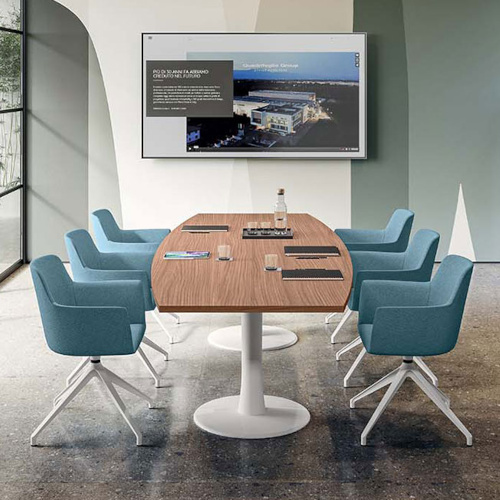
Choosing the Right Conference Room Meeting Table
A conference room can have excellent lighting, attractive chairs and modern technology, yet still feel awkward if the table is wrong for the space.
The conference room meeting table usually occupies the largest portion of the room and determines where people sit, how easily they move around and how naturally conversations happen.
That makes it much more than a decorative centrepiece.
The dimensions and shape of the table can influence how the entire meeting room functions.
Table of Contents
- Bigger Is Not Automatically Better
- Round Tables Change the Dynamic of Smaller Meetings
- Rectangular Tables Suit Structured Meetings
- Think About Where Everyone Will Look
- Power and Cables Deserve Early Attention
- Chairs Change the Space Required
- A Meeting Room Is Still a Workplace
- The Best Table Matches the Meetings That Actually Happen
- Frequently Asked Questions
Bigger Is Not Automatically Better
A large table can appear impressive, but squeezing the biggest possible table into a room often creates practical problems.
Chairs need room to move backwards.
People need to walk around seated colleagues.
Doors and storage cupboards still need to open.
Screens and presentation areas should remain visible.
A conference meeting room table therefore needs to be chosen according to the usable room dimensions rather than simply the number of people it can theoretically seat.
Leaving comfortable circulation space can make a smaller table feel far more appropriate than a larger one.
Round Tables Change the Dynamic of Smaller Meetings
A round meeting room table can work particularly well where conversation is more important than hierarchy.
Because there is no obvious head of the table, participants have similar sightlines towards one another.
Round tables can also make effective use of smaller meeting rooms when a long rectangular table would dominate the available space.
However, they are not ideal in every room.
As the required seating capacity increases, a round table needs significantly more diameter. At that point, rectangular, boat-shaped or other configurations may use floor space more efficiently.
The shape should follow the purpose of the room.
Rectangular Tables Suit Structured Meetings
Rectangular tables remain common because they are straightforward and work well in a wide range of rooms.
They can provide clear seating positions and are often well suited to presentations, formal meetings and larger groups.
A long office table for meeting use can also help organise equipment, documents and shared materials.
However, length affects communication.
When a table becomes very long, people at opposite ends may feel separated from the main discussion.
For rooms used mostly by small groups, choosing a table proportionate to the usual number of participants can create a more connected atmosphere.
Think About Where Everyone Will Look
Meeting rooms increasingly contain screens, video conferencing equipment or presentation displays.
The table should support visibility rather than compete with it.
A table that is too wide may make it difficult for people to see a wall-mounted display comfortably. High decorative features positioned in the middle can interfere with sightlines.
For video meetings, seating positions also matter because cameras need a usable view of participants.
Before choosing a conference room meeting table, it can help to imagine an actual meeting taking place rather than looking at the empty room.
Who needs to see the screen?
Where will the presenter stand?
Where will power be needed?
These questions often reveal whether a particular table format will work.
Power and Cables Deserve Early Attention
Laptops, screens, speakerphones and chargers are common in meeting rooms.
Without cable planning, even an attractive table can quickly become covered with extension leads and loose cables.
Some meeting tables can accommodate integrated power or cable access. In other rooms, floor boxes, wall outlets or nearby power points may determine where the table can realistically sit.
Thinking about power before delivery is considerably easier than trying to solve the problem once a heavy table is in place.
Chairs Change the Space Required
Table dimensions only tell part of the story.
Large executive chairs need more room than compact meeting chairs. Chairs with arms may not slide fully underneath certain tables.
A room that appears to accommodate ten seats on paper may feel uncomfortable once people are seated.
When evaluating meeting furniture, consider the table and chairs as one arrangement.
A Meeting Room Is Still a Workplace
Meeting spaces should also be considered from a workplace safety perspective.
Business.gov.au recommends identifying workplace hazards, assessing risks, implementing controls and reviewing those controls as part of creating a safer workplace.
The Australian Government’s workplace safety information provides a useful framework businesses can apply when planning work environments.
For a meeting room, this can include obvious practical considerations such as clear movement areas, stable furniture and avoiding poorly positioned cords or equipment.
The Best Table Matches the Meetings That Actually Happen
It is easy to design a conference room for the occasional twenty-person meeting even when six people use the room almost every day.
A more useful approach is to design around typical use.
If the room is primarily used for small collaborative discussions, a round table may create the right atmosphere.
If formal presentations and client meetings are common, a rectangular or larger conference table may be more appropriate.
If the room regularly serves several purposes, flexible tables may be worth considering.
The most successful meeting room is not necessarily the one that looks most impressive when empty.
It is the one that feels natural when people are actually using it.
Find the Perfect Meeting Table
Explore a range of meeting and conference room tables suitable for different office layouts and team sizes.
FAQs About Conference Room Meeting Tables
What shape is best for a conference meeting room table?
It depends on the room and meeting style. Rectangular tables work well for many formal settings, while round tables can suit smaller collaborative meetings.
Is a round meeting room table good for small rooms?
It can be. Round tables can encourage conversation and may work well in compact rooms, although sufficient clearance around the chairs is still important.
How large should a conference room meeting table be?
The table should suit the usual number of users while leaving enough space for chairs, circulation, doors and other furniture.
Should a meeting table include power outlets?
Integrated power can be useful where participants regularly use laptops and other devices, but the right solution depends on the room’s electrical setup.
Should I buy the chairs or meeting table first?
Ideally, consider them together. Chair dimensions affect how many people can sit comfortably and how much circulation space the room requires.


